Social run: what is it? How it works, how it differs from a Lauftreff, and social runs in Cologne and Düsseldorf
Meet at a café, run about 5 km, then sit down together: what a social run is, how it works and where you can join one in Cologne and Düsseldorf.
Chris Mühlnickel · 18 October 2026 · 5 min read
In short
- A social run is an open group run with no membership or fees, and the after is part of it: it usually starts and finishes at a café (sources: Journal Frankfurt, hessenschau).
- Typical features are around 5 km, several pace groups and dates posted on Instagram. It differs from the classic German Lauftreff mainly in its lifestyle (source: hessenschau).
- According to Strava, running clubs grew by 59% in 2024, and new running clubs more than tripled in 2025 (sources: Strava Year in Sport 2024 and 2025).
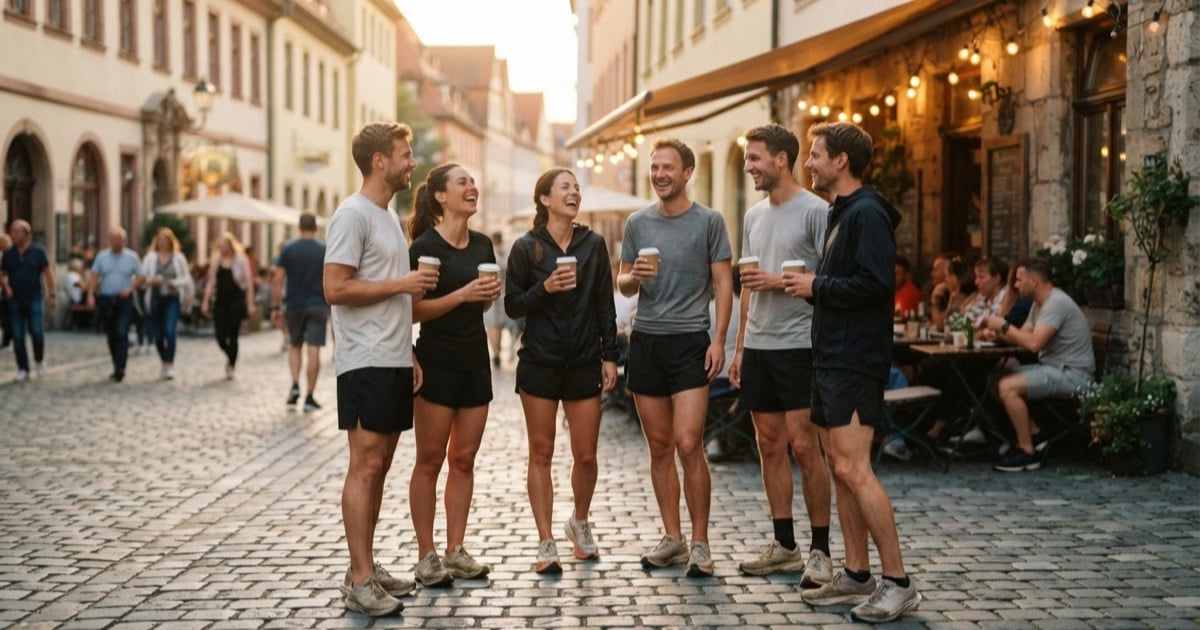
You meet at a café or a store, after about five kilometres everyone sits down together with a flat white or a matcha, and if it's your first time, you leave knowing a few new people. That's a social run. In recent years the format has joined the traditional running group in many German cities, and it appeals above all to people who don't run for a personal best. Here's what a social run is, how it works, how it differs from a classic Lauftreff (a German drop-in running group) and a running club, and where to find one in Cologne and Düsseldorf.
What is a social run?
A social run is an open group run where being together matters as much as the running. Journal Frankfurt describes the idea like this: a group meets at one spot and goes jogging together from there, usually ending at a café. Sports psychologist Alisha Lenz put it to the hessenschau broadcaster this way: what makes it special is that the run is always tied to a social event, and everything around it is part of the deal. You can join without commitment, membership or fees, and it's "not about performance" (sources: Journal Frankfurt, 7 April 2026; hessenschau, 10 November 2025).
The groups behind these runs usually call themselves a social run club or simply a run club. They're often organized by cafés, fashion and sports brands, or just by friends who at some point started bringing more people along.
How a social run works
Every club does it a little differently, but some elements show up almost everywhere:
- A meeting point that's also the after-party. You start at a café, a bar or a store, and that's where the group ends up again.
- A short distance. Usually around 5 kilometres; some clubs add a longer loop.
- Several pace groups. Bigger clubs split up by pace so nobody ends up running alone at the back (source: Journal Frankfurt).
- Free and open. You rarely need to sign up; dates and meeting points are usually announced on Instagram.
- The after. Coffee, cake, sometimes a DJ or an evening drink. This is where the conversations happen that many people come for in the first place.
An example from Düsseldorf: the Stadtfreunde host a social run from the Cafébar Die Fliese, running about 5 kilometres, followed by coffee and cake together.
Social run, Lauftreff or club?
Running together isn't new. As early as the 1960s and 1970s, hobby runners in Germany met in loose groups outside of sports clubs, and that's how the Lauftreff was born (source: Journal Frankfurt). According to the hessenschau, the difference to the social run lies "above all" in the lifestyle: instead of tea from a paper cup it's cappuccino in a café, the crowd is younger and organizes itself on Instagram (source: hessenschau).
| Social run | Lauftreff | Running club | |
|---|---|---|---|
| Membership | none | usually none | membership fee |
| Focus | community, the after | running regularly | training and racing |
| Meeting point | café, store, bar | car park, sports ground, running shop | club grounds, stadium |
| Organization | Instagram, WhatsApp | fixed times, often via clubs or shops | coaches, fixed groups |
| Typical distance | around 5 km | depends on the group | according to the training plan |
Which one suits you depends on what you're looking for. A more detailed look at every format, from parkrun to running club, is in our article on types of running groups.
Why social runs are so popular
The numbers that exist mostly come from Strava. According to its 2024 annual report, the platform saw a 59 percent increase in running clubs and 18 percent more group runs with ten or more participants. A year later, new running clubs on Strava had more than tripled, and 39 percent more people from Gen Z than from Gen X said they use fitness to meet people who share their interests (sources: Strava Year in Sport 2024 and 2025).
The explanation is simple: running is easy, costs nothing and fits well with meeting people. If you're new to a city, or want to meet people somewhere other than a bar, a social run is an easy way in, even without running experience.
Social runs in Cologne and Düsseldorf
Cologne and Düsseldorf have plenty to choose from. On We Up, 31 social run clubs are listed in Cologne and 24 in Düsseldorf (as of 18 October 2026). A few examples that show how varied the format can be:
- Social Run Cologne: everyone is welcome; it's about meeting new people and getting better together.
- Sunday Running Club Köln and Sunday Running Club Düsseldorf by the fashion brand Another Cotton Lab: every Sunday with a 10 km and a 5 km group from the store.
- Run For Love Köln: a singles run where sport and flirting go together.
- PAUS in Düsseldorf: sees itself as a break from the screen, a weekly ritual for community and a calm reset.
- Stadtfreunde Running Club in Düsseldorf: about 5 km from the café bar, then coffee and cake.
You'll find every club with meeting points and weekdays in our overview of run clubs in Cologne and Düsseldorf. Social run clubs exist in other cities too, such as the Social Run Club Bonn or the kr.runningclub in Krefeld.
Tips for your first social run
- Check Instagram first. Dates, meeting points and pace are almost always posted there, and so are last-minute changes.
- Arrive a few minutes early. That gives you time to introduce yourself and ask which group fits your pace.
- Pick the slower group if you're unsure. At a social run it's completely fine to chat at the back instead of running up front.
- Leave time for the after. The coffee after running isn't an add-on; it's when you actually get to know people.
If it's your first time joining a running group, you'll find more tips on how it works, pace and etiquette in our article Your first time at a running group.
Sources
- journal-frankfurt.de/journal_news/freizeit-163/Lauftreffs-i…
- hessenschau.de/panorama/instagram-hype-social-run-club-viel…
- athletechnews.com/strava-2024-fitness-report-highlights-tre…
- webull.com/news/13961203642123264
Frequently asked questions
What is a social run?
An open group run where being together matters as much as running. People usually meet at a café or store, run about 5 kilometres and then sit down together. There's normally no membership or fee.
How is a social run different from a Lauftreff?
Both are open running groups with no club obligations. A social run puts more weight on meeting up afterwards, usually starts at a café or store and organizes itself on Instagram. According to the hessenschau, the crowd is younger.
Do I need to be fast to join a social run?
No. Social runs aren't about performance, and many clubs run in several pace groups. If you're unsure, join the slowest group.
Where can I find social runs in Cologne and Düsseldorf?
On We Up, 31 social run clubs are listed in Cologne and 24 in Düsseldorf (as of October 2026), with meeting points and weekdays on the overview pages for both cities.