Running Shoes for Beginners: What Actually Matters (No Sales Pitch)
Pronation, drop, cushioning foam: your first running-shoe purchase buries you in marketing. The independent take on what actually matters – and what you can ignore.
Daniel Gruber · 13 July 2026 · 4 min read · Updated 28 July 2026
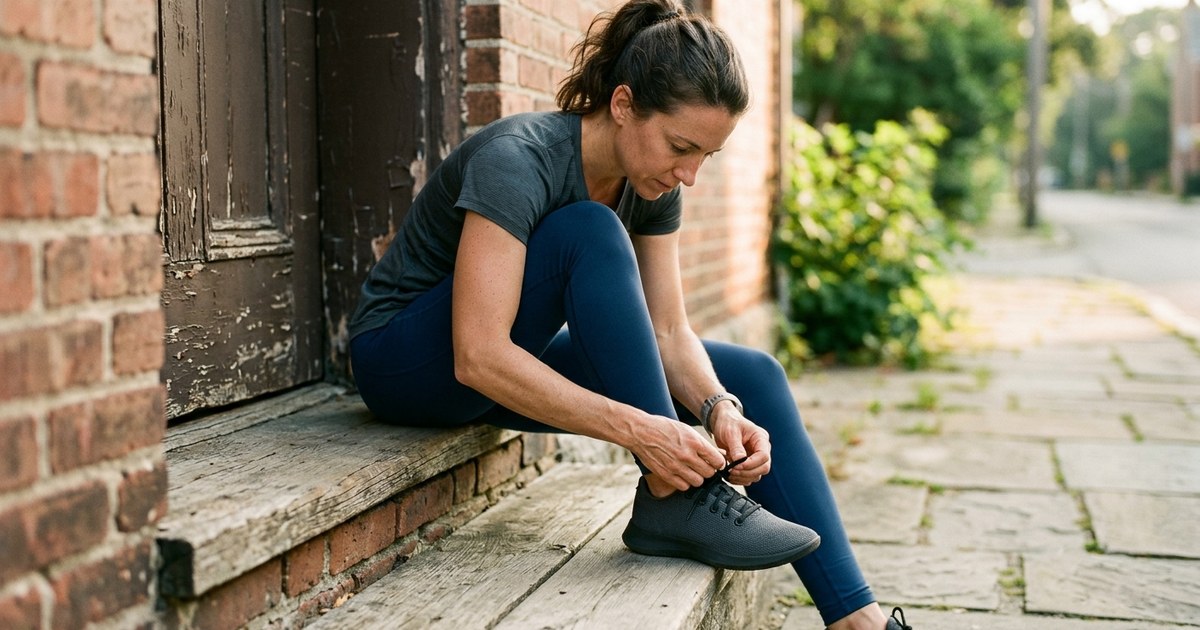
First running-shoe purchase, and instantly there's a wall of jargon in front of you: pronation, drop, stability, cushioning foam with made-up names. Most of it you can safely ignore. Here's the independent version – no affiliate link and no model list – of what actually matters in your first running shoe.
What actually matters: fit and comfort
The best-evidenced selection criterion is also the simplest: the best running shoe is the one that feels most comfortable to you. Sports scientist Benno Nigg calls it the "comfort filter" – your body intuitively picks the shoe that suits your natural movement pattern (Nigg 2015). In a prospective study, a shoe perceived as more comfortable and better cushioned was associated with a lower injury risk (PMC 2024). Important: that's an association, not a guarantee – but as a practical rule of thumb, if it feels good, it's your shoe.
The right size
The most common beginner mistake is a shoe that's too small. Your feet spread and swell as you run, so you usually need half to a full size larger than your everyday shoe (Runner's World, ausdauerclub). As a check: there should be about a thumb's width of room in front of your longest toe. And try shoes on in the afternoon or evening, when your feet are a little larger than in the morning (sport-bittl).
What you can safely ignore: the pronation scare
Now for the biggest myth. The decades-old model goes: get your running gait analyzed, buy a stability shoe to match your "overpronation," and it protects you from injury. The evidence for this is surprisingly thin. In a review of over 7,000 recruits, prescribing shoes by foot or pronation type did not reduce injury risk (Malisoux & Theisen 2020); several military studies reached the same conclusion (Knapik). Overpronation doesn't reliably predict injury anyway – 40 to 50 percent of people who overpronate get no overuse problems at all (Wikipedia). To be fair: one study found a benefit from stability shoes, but only for already-pronated feet – no reason to recommend them to all beginners. Bottom line: start with a neutral shoe unless you have a specific injury history.
Cushioning and drop – briefly
Two terms worth knowing but not overthinking. The drop is the height difference between heel and forefoot, measured in millimetres (Wikipedia). Most running shoes sit between about 4 and 12 millimetres; a higher drop tends to relieve the Achilles and calf, a lower one feels more "natural" (Runner's World). For getting started, a well-cushioned, moderate model is almost always right – you don't need more science than that at the beginning.
What else the marketing sells
Two more trends you can stay relaxed about. Neither barefoot/minimalist shoes nor heavily cushioned "maximalist" shoes are demonstrably the best or safest choice – the data doesn't favour any category (Running Clinic). Beginners who switch abruptly to minimalist shoes actually have a higher injury risk; any transition has to happen slowly (REI). And expensive doesn't mean safer: in one study, pricier shoes came with more injuries, while cheap and mid-priced ones were perceived as just as comfortable (Malisoux & Theisen 2020). A solid mid-priced beginner shoe is entirely enough.
How to buy right
The best buying advice isn't a website, it's a good specialist store. Get advice, try several models and run in them – on a treadmill or a few steps in the shop – and decide based on how they feel (sport-bittl, ausdauerclub). Your second, free opinion comes from your running group: experienced runners have seen through most marketing promises long ago. And once your shoes have around 500 to 800 kilometres on them, it's time for a new pair – the range is rough and depends on weight, terrain and running style; rotating two pairs makes both last longer.
What it comes down to
You can ignore the pronation scare and the foam brand names. What counts: the shoe that feels best, in the right size, bought where you can run in it. The best second opinion is free – your running group. You'll find one, and learn what to expect from running, on the runners' page and in the overview.
Sources
- pmc.ncbi.nlm.nih.gov/articles/PMC7740063
- pubmed.ncbi.nlm.nih.gov/26221015
- pmc.ncbi.nlm.nih.gov/articles/PMC12541242
- pubmed.ncbi.nlm.nih.gov/20576837
- therunningclinic.com/runners/blog/archives-anglaises/first-…
- rei.com/learn/expert-advice/basics-of-barefoot-minimalist-r…
- runnersworld.de/laufschuhe/welcher-laufschuh-passt-zu-mir
- runnersworld.de/laufschuhe/sprengung
- runnersworld.de/laufschuhe/wie-lange-halten-laufschuhe-1
- ausdauerclub.de/equipment/laufschuhe-beratung
- sport-bittl.com/de/online-beratung/kleiner-running-ratgeber…
- de.wikipedia.org/wiki/Laufschuh
- en.wikipedia.org/wiki/Pronation_of_the_foot
- de.wikipedia.org/wiki/Sprengung_(Schuh)
Frequently asked questions
- How long do running shoes last?
- Manufacturer figures range from roughly 400 to 800 kilometres, and that spread is wide for a reason: your weight, stride and running surface all feed into it. More reliable than the odometer are the signs – the cushioning feels flat, the tread is worn down along the outer edge, or you pick up aches that weren't there before.
- Can I start out in ordinary trainers?
- For the first two or three outings, yes. Long term, no. Everyday trainers aren't built to absorb the impact of every stride – and you'll usually notice that in your shins or knees before your feet.
- Do I need special shoes for trails and forest paths?
- On firm forest tracks your normal running shoe is fine. Proper trail tread only pays off once you're regularly on muddy, root-covered or steep ground.
- How much should I spend on a first pair?
- Less than the shop will suggest. The mid price range covers everything you actually need; the most expensive models mainly sell racing technology that does nothing for a beginner. Last season's models are almost always the best value.
- Do I need two pairs to rotate between?
- Not at the start. Rotating only becomes interesting once you're running several times a week – then letting the cushioning recover between runs can make both pairs last longer.