Running in the Heat: How to Keep Training Safely in Summer
30 degrees and your running motivation is melting? You don't have to stop – just run smarter. How to keep training safely in the heat, including the warning signs you should know.
Chris Mühlnickel · 8 July 2026 · 4 min read · Updated 28 July 2026
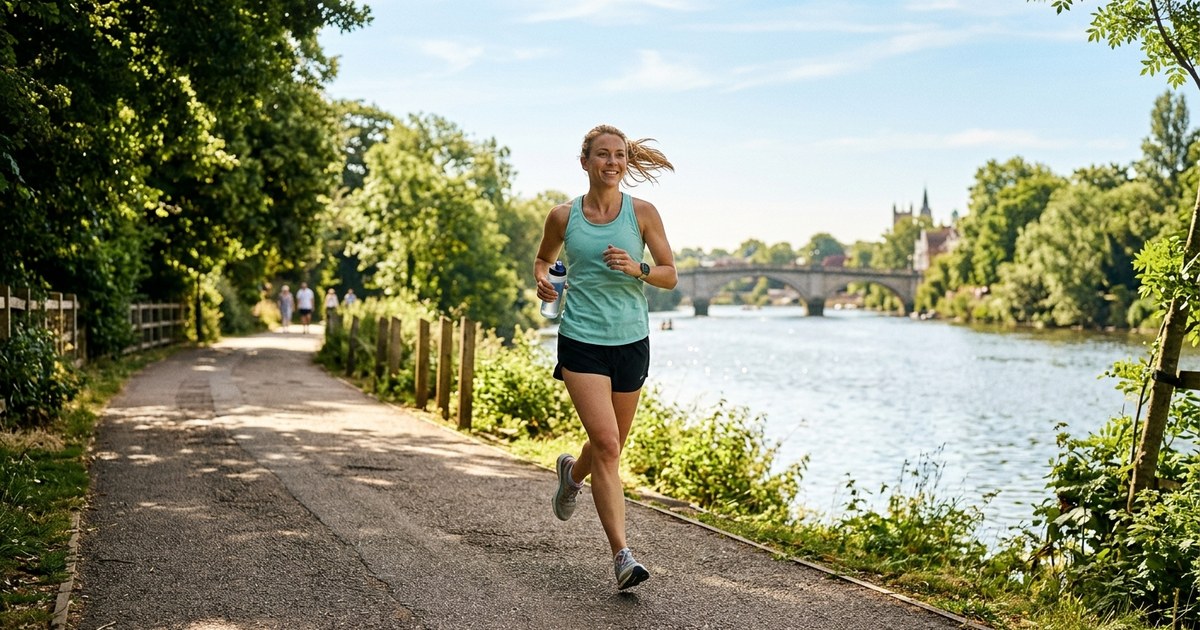
Summer, 30 degrees, and your running motivation melts faster than the ice cream in your hand. That's no reason to stop – you just have to run smarter. Here's how to keep training safely even in the heat, with the warning signs you absolutely need to know.
The right time: early or late
The biggest lever is timing. Avoid the midday and afternoon heat between roughly 11 a.m. and 6 p.m., when temperature, UV radiation and heated surfaces peak (Runner's World). It's coolest – and lowest in ozone and UV – early in the morning; late evening is the second-best option, even though the ground still radiates the day's heat (Runner's World). Germany's Federal Environment Agency explicitly recommends scheduling sport in the evening, better still in the early morning hours (Umweltbundesamt). A handy side effect: in summer, most group runs shift to exactly these cooler slots anyway.
Run slower – and watch your heart rate
In the heat, your body diverts blood to the skin to cool down while your muscles still need oxygen. The result: at the same pace, your heart rate climbs by around 5 to 15 beats per minute (Runner's World). The mistake would be to insist on your usual pace anyway. Instead, steer by effort or heart rate, not by the clock: the same effort means slower and shorter on hot days – and that's completely normal. The simplest gauge is the talk test: if you can still speak, the intensity is right. Better to move tempo runs and hard intervals to cooler days (WLV).
Hydrate – but properly
Drink enough across the day and before and after your run; for sessions over about 45 to 60 minutes, electrolyte drinks make sense, because you lose minerals through sweat (Runner's World, WLV). But the other direction matters just as much: don't drink beyond your thirst. Too much fluid can cause hyponatremia – a dangerously low blood-sodium level that can become serious (Pharmazeutische Zeitung). So the simple rule is: drink to thirst, not "as much as possible".
Clothing, sun and route
Wear light-coloured, breathable, loosely fitting clothing, plus a head covering and sunglasses; apply sweat-resistant sunscreen about 30 minutes before you start (WLV, Runner's World). For your route: seek shade. Forest paths, densely planted parks and routes near water are noticeably more pleasant thanks to evaporative cooling than open, heated asphalt (Runner's World). An honest caveat: on high-ozone days, the air on the city outskirts and in the countryside is often worse than in the city centre – "a park is automatically healthier" isn't necessarily true then (Umweltbundesamt).
Give your body time
Your body adapts to heat, but not overnight: over roughly 10 to 14 days of regular training, it starts to sweat earlier and more efficiently, and your heart rate reacts more moderately (Runner's World). The AOK advises giving your body a few days to acclimatise before intense activity in the heat (AOK). In other words: the first hot days are the riskiest – take it especially easy then.
The warning signs: when to stop immediately
This is the most important section. Heat exhaustion announces itself through headache, dizziness, intense thirst, nausea, weakness, irritability or coordination problems – and can quickly progress to heat stroke (AOK). If you notice a headache, dizziness or nausea while running, stop immediately and get into the shade (WLV). Heat stroke – recognisable by hot skin, a racing pulse, cramps, confusion and a body temperature over 40 degrees – is a medical emergency: call the emergency number (112 in Germany) at once, as it can be fatal (AOK). And on some days, the smartest decision is not to run outdoors at all: in extreme heat, high ozone, or if you belong to a sensitive group (Runner's World, Umweltbundesamt).
Stay safe: don't run through the heat alone
Finally, a thought that goes beyond clothing and how much you drink: try not to run alone on hot days. For one thing, group runs move to the cool morning and evening hours in summer – exactly the right time. For another, in a group someone notices if you're not doing well and can react before dizziness turns into an emergency. You'll find a running group near you in the overview; more about running is on the runners' page. This article is no substitute for medical advice – if you have any pre-existing conditions or are in doubt, talk to your doctor first.
Sources
- runnersworld.de/training-basiswissen/laufen-bei-hitze-im-so…
- runnersworld.de/training-basiswissen/pulsverhalten-im-sommer
- aok.de/pk/magazin/koerper-psyche/herz-und-kreislauf/hitzsch…
- calw.wlv-sport.de/home/details/news/laufen-bei-hitze-tipps-…
- dwd.de/DE/leistungen/hitzewarnung/hitzewarnung.html
- umweltbundesamt.de/themen/bei-intensiver-sonne-sport-vermei…
- pharmazeutische-zeitung.de/ausgabe-282015/zu-viel-trinken-k…
- aerzteblatt.de/news/belastungsbedingte-hyponatriaemie-wenn-…
- de.wikipedia.org/wiki/Hitzschlag_bei_Menschen
Frequently asked questions
- At what temperature should I skip the run?
- There's no fixed number – what matters is temperature, humidity and direct sun together. A muggy 28°C day can be harder than a dry 32°C one. Take your cue from the German Weather Service heat warnings and from how the first few minutes actually feel.
- Is water enough, or do I need electrolytes in the heat?
- For ordinary runs, water is enough. Electrolytes only become relevant on long sessions with very heavy sweating. More important than the amount is drinking to thirst: drinking plain water well beyond thirst can unbalance your sodium levels.
- Is a treadmill the better choice in a heatwave?
- If the alternative is only the midday heat, then yes – with no guilt attached. Indoors you can complete the session in controlled conditions instead of skipping it. Just remember a room without airflow heats up too: fan on, and start easy, applies indoors as well.
- Can I hold my usual pace if I just drink more?
- No. Drinking replaces lost fluid, not the extra cardiovascular load: in the heat your body is cooling itself at the same time, so your heart rate sits higher at the same pace. Adjusting pace isn't backsliding – it's adapting to changed conditions.