Running With Your Dog: A Beginner's Guide for You and Your Four-Legged Runner
Running with your dog can turn into the best part of both your days – if age, breed, pace, and gear are right from the start. Here's how to begin safely, together.
Daniel Gruber · 10 September 2026 · 4 min read
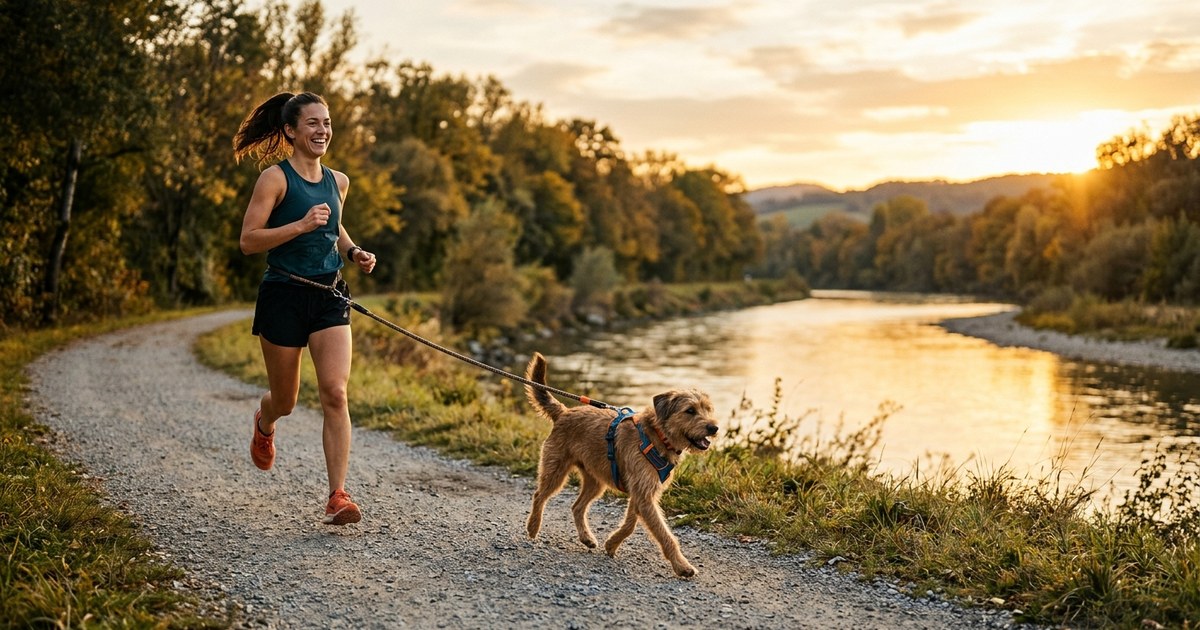
For a lot of runners, a dog is the whole reason they get out the door on days they'd otherwise skip: no weather is bad enough when the dog needs a walk anyway. But to keep the shared run from becoming a problem for joints, paws, or your dog's heart rate, a little preparation goes a long way – for both of you.
Is your dog actually ready to run?
The most common mistake with running dogs: starting too soon. Puppies and young dogs have open growth plates, and regular, strenuous running on hard surfaces can cause lasting damage to joints that simply aren't ready for it yet (source: AKC). How long that takes depends heavily on size: small breeds like Dachshunds or Chihuahuas are usually fully grown by six to ten months, medium breeds like Border Collies by around ten to twelve months – while large and giant breeds such as Labradors, Golden Retrievers, or Great Danes can take 14 to 24 months before their growth plates are truly closed (source: AKC). When in doubt, a veterinary check is the most reliable way to confirm your dog is ready.
Not every breed is built for running
Some dogs seem built for the long haul: Vizslas, Weimaraners, German Shorthaired Pointers, Rhodesian Ridgebacks, Border Collies, and Labradors are known as enthusiastic, high-endurance running partners (source: AKC). Others should never be taken on distance runs at all – above all brachycephalic (flat-faced) breeds like Pugs, French and English Bulldogs, or Boston Terriers. Their narrowed airways make sustained exertion risky, especially in warm weather; they can struggle to breathe or even collapse (source: PetMD, Diamond Pet Foods). For these breeds, short, calm walks during the cooler parts of the day are the better choice – running simply isn't the right sport for them.
Building up mileage gradually
Just like for people starting to run, the rule for dogs is: walk first, then add distance in small steps. A well-tested framework mirrors the logic of a human couch-to-5k plan, adapted for a dog's timeline (source: Chewy, Ruffwear). Before any jogging starts, your dog should be comfortable walking briskly for 30 to 45 minutes. In the first one to two weeks, add short one-minute jogging intervals alternated with walking breaks; in weeks three and four, extend those intervals until continuous 20-minute runs are possible around the four-week mark. Along the way, build in at least one or two rest days a week, set the pace to match your dog rather than the other way around, and stop immediately at any sign of limping, unusually heavy panting, or lagging behind.
Paw pads, heat, and water breaks
Dogs can't cool down by sweating the way we do – they have sweat glands mostly just on their paws, and rely primarily on panting, which becomes far less effective in heat and high humidity (source: Cornell University College of Veterinary Medicine). That's why dogs overheat faster than humans, and heatstroke is a genuine emergency. A simple rule of thumb for hot pavement: press your palm to the ground for ten seconds – if it's too hot for your hand, it's too hot for your dog's paws. Even at around 30°C air temperature, asphalt can reach well over 50°C, and pad burns can happen within seconds (source: AKC). Run early morning or evening when possible, stick to grass or trail where you can, and always carry water for your dog on longer runs.
The right gear: harness over collar
For regular running, a well-fitted harness is the safer choice over a collar: it spreads pulling force across a larger part of the body instead of concentrating it on the neck and throat – important if your dog suddenly lunges or veers (source: SafeWise). Pair it with a hands-free leash with a waist belt or a built-in bungee section, which keeps your hands free to run and absorbs sudden pulls instead of transferring them straight to your arm or shoulder.
Running groups that think about your dog too
Most guides to running with a dog treat it as a strictly solo activity between owner and dog. But plenty of dog owners are looking for the opposite: other runners whose dogs are welcome too, both for safe dog-to-dog socializing and because running with company beats running alone. That's exactly the niche behind formats like canicross, where the dog actively pulls in a harness – it already has its own dedicated communities and meetups (source: Whole Dog Journal). We Up isn't a dedicated platform for running with dogs, but among the running groups some are dog-friendly or built specifically around dog owners – worth checking if that's what you're after.
If you're both new to running, our guide Getting started with running covers most of the basics on pace, gear, and building up mileage that apply to both of you. And if you're looking for the right group for yourself and your dog, the overview is a good place to start.
- Vet check before the first run Confirm your dog's age, breed, and health actually allow sustained running – especially important for young dogs with growth plates still open.
- Weeks 1–2: Walking with short jogging intervals Start with 30–45 minutes of brisk walking, adding one-minute jogging intervals alternated with walking breaks.
- Weeks 3–4: Extend the intervals Gradually lengthen the running intervals until continuous runs of about 20 minutes are possible – with at least one rest day between sessions.
- Before every run: weather and paw check Do the hand test on pavement and switch to grass or the cooler morning/evening hours when it's hot.
- During the run: match pace and water breaks to your dog Carry water, pause regularly, and stop immediately at any sign of limping, heavy panting, or lagging behind.
- Check your gear A well-fitted harness instead of a collar, plus a hands-free leash with a waist belt or bungee element for safe control without tying up your hands.
Sources
- akc.org/expert-advice/health/best-running-dogs
- akc.org/expert-advice/health/when-does-my-puppy-finish-grow…
- akc.org/expert-advice/health/dog-paws-hot-pavement
- petmd.com/dog/general-health/summer-safety-tips-for-flat-fa…
- diamondpet.com/blog/health/conditions/exercise-caution-brac…
- vet.cornell.edu/departments-centers-and-institutes/riney-ca…
- chewy.com/education/dog/training-and-behavior/how-to-run-wi…
- ruffwear.com/blogs/explored/4-week-5k-training-plan-for-run…
- safewise.com/pet-harness-vs-collar
- whole-dog-journal.com/training/all-about-canicross
Frequently asked questions
- How old does my dog need to be to run with me?
- Only once growth is complete – sustained running on hard ground loads joints whose growth plates are still open. When that point arrives depends heavily on breed and adult size; that's a question for your vet, not for an internet rule of thumb.
- Can my dog eat before or after a run?
- Leave time between a meal and the run, in both directions. In large, deep-chested breeds especially, exertion on a full stomach is associated with the risk of gastric torsion – an emergency. Water is fine, calmly rather than gulped.
- My dog wants to sniff at every corner – how do I get a run done?
- Separate the two activities: a sniffing walk where he decides, and a running route where you set the pace. If you deliberately build in a few sniff stops early on and then end them, he learns the difference faster than if you drag him the whole way.
- How do I tell it's becoming too much for my dog?
- He drops behind or dawdles, pants heavily with a broad tongue, seeks shade unprompted, or lies down. Unlike you, your dog won't call it off – many run past their limit out of loyalty. So the pace and the finish are your decision, not his.