Berlin Half Marathon 2027: Entries, Course and Date
On 4 April 2027 the GENERALI BERLINER HALBMARATHON runs from the Tiergarten through the Brandenburg Gate. The ballot is over – here are the routes to a place that remain, how the course runs and how to use it as a spring test.
Daniel Gruber · 2 October 2026 · 8 min read
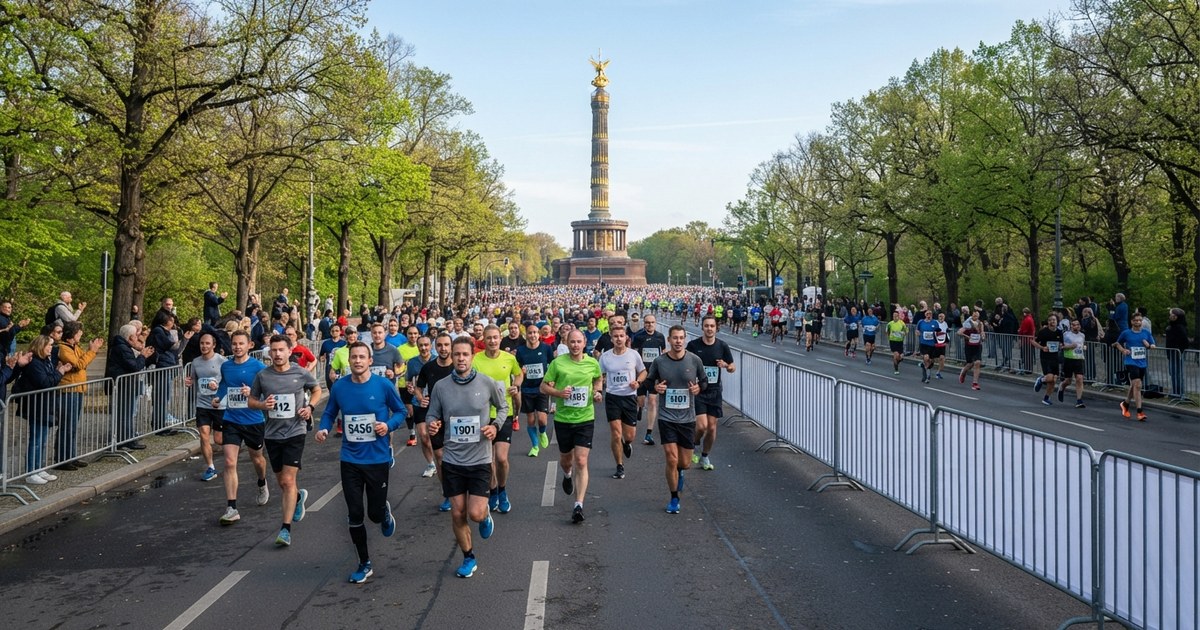
The GENERALI BERLINER HALBMARATHON 2027 takes place on Sunday, 4 April 2027 – and if you're only thinking about it now, the ballot is no longer an option. Places for the run were drawn back in June 2026. There are still ways to the start line on Straße des 17. Juni, though. This article covers what they are, what makes the course special and why a race in early April fits well into a spring plan.
Key facts at a glance
| Aspect | Details |
|---|---|
| Date | Sunday, 4 April 2027 (46th edition) |
| Start | Straße des 17. Juni, between the Brandenburg Gate and the Victory Column |
| Finish | just beyond the Brandenburg Gate |
| Start times | 9:15 am inline skating, 9:55 am wheelchair and handbike, from 10:05 am the run in several waves |
| Distance | 21.0975 km, maximum elevation difference of 4.3 m |
| Time limit (run) | 3:15 hours from crossing the start mat |
| Entry fee (run) | €89 |
| Registration (run) | Ballot (registration 2 April–28 May 2026), results sent on 16 June 2026 |
| Other routes in | Charity, official travel partners, SCC preparation course, social ticket |
| Inline skating | Registration until 11 March 2027 as long as the cap is not reached; €66 or €73 |
| Organiser | SCC EVENTS GmbH |
(Source: generali-berliner-halbmarathon.de, pages Infos zur Anmeldung, Lauf, Inlineskating, Strecke and Event-FAQ)
Places for 2027: the ballot is over
SCC EVENTS allocates the running places by ballot – as is common for several races in the SuperHalfs series, which Berlin has belonged to since 2024. That gives every registration in the window the same chance. For 2027 you could register from 2 April to 28 May 2026, just days after the 2026 edition. The results arrived by email on 16 June 2026, after which the €89 entry fee was charged – only to those who were drawn (generali-berliner-halbmarathon.de, page Lauf).
One feature many people overlook: you could register as a team of two or three. If the team is drawn, everyone gets a place. There is no team ranking, and if someone drops out later, the others keep their places (generali-berliner-halbmarathon.de, page Lauf).
No luck in the ballot: the routes the organiser lists
If you missed out or missed the ballot, the organiser says these options remain (overview and registration on the organiser's page):
- Charity place: Through the official charity partners, including Generali's The Human Safety Net, places are available in exchange for a donation – explicitly even when the race is sold out (generali-berliner-halbmarathon.de/anmelden/charity). Each partner sets the donation amount.
- Travel operators: Official partners, organised in the association T.O.U.R.S., sell travel packages with a guaranteed place. The organiser stresses that only the operators listed there are authorised (generali-berliner-halbmarathon.de/anmelden/reiseveranstalter).
- SCC EVENTS preparation course: The three 12-week courses in the Olympiapark (12 or 13 January to 30 or 31 March 2027, morning or evening) can be combined with a place for €130 on top of the course fee. The access code for registration is released at the end of January. Requirement: being able to run for 60 minutes without stopping (scc-events.com, Trainingsangebote).
- Social ticket: 50 places go for €35 to people with a Berlin Sozialticket S; requests by email to sozialticket@scc-events.com (generali-berliner-halbmarathon.de, page Lauf).
The organiser does not list a waiting list or an official place exchange for the run on its registration pages.
What you need to know about your place
Places are personal. They cannot be transferred to another person or to another year, and the entry fee is generally not refunded. You can only insure it with the GENERALI Startplatzrücktrittsversicherung (entry cancellation insurance), which can only be taken out directly at registration. In case of pregnancy, the right to start can be deferred by up to three years as a goodwill gesture (generali-berliner-halbmarathon.de, Infos zur Anmeldung).
Everyone born in 2011 or earlier is eligible. Walkers are allowed as long as they stay within the 3:15 time limit; Nordic walkers are not (generali-berliner-halbmarathon.de, page Lauf). Race packs are only handed out in person at the HALBMARATHON EXPO, not on race day (Event-FAQ).
The course: straight across Berlin with no real climbs
The course is a loop through the west and centre of the city. From the start on Straße des 17. Juni you pass the Victory Column towards Ernst-Reuter-Platz and run along Otto-Suhr-Allee to Charlottenburg Palace (around km 3 to 4). Via Schloßstraße and Droysenstraße you reach Kurfürstendamm, pass the Kaiser Wilhelm Memorial Church (km 9) and continue along Tauentzienstraße to Wittenbergplatz. Potsdamer Straße leads to Potsdamer Platz (km 12), then Leipziger Straße to Gendarmenmarkt (km 14 to 15). Via Französische Straße and Grunerstraße you reach Karl-Marx-Allee with the turning point at Strausberger Platz (km 17), then come back past the TV Tower, the Rotes Rathaus and Berlin Cathedral and run along Unter den Linden through the Brandenburg Gate to the finish (course map, generali-berliner-halbmarathon.de/das-rennen/strecke).
A big city hardly gets flatter: according to the elevation profile, there are 4.3 metres between the lowest and the highest point. The start at the Victory Column is at 33.6 m, the highest point at Alexanderplatz at 37.3 m, and the finish at the Brandenburg Gate at 34.4 m (elevation profile description, generali-berliner-halbmarathon.de).
There are six aid stations, all on the right in the running direction, with refill for your own drinking systems. Important for planning: at km 12.3 there are only Maurten gels and no water; the next water station follows at km 14.1. Around 40 bands play along the course (generali-berliner-halbmarathon.de/das-rennen/strecke). Bags are not allowed in the start area: at registration you choose either a free poncho at the finish or a clothing bag for €5 – you can't have both (page Lauf).
On wheels, in a wheelchair, over the mile
The half marathon is not just a running event. The inline skaters start first at 9:15 am on the same course. There is no ballot for them: registration runs until 11 March 2027, as long as the participation cap is not reached earlier, and costs €66 or €73 depending on the quota. Helmets are mandatory (generali-berliner-halbmarathon.de/anmelden/inlineskating). Wheelchair users and handbikers start at 9:55 am and can also register until 11 March 2027 (Infos zur Anmeldung).
On the Saturday before, 3 April 2027, the Garmin BERLIN MILE takes place at 2 pm: 1.609 km from Schlossplatz in front of the Humboldt Forum along Unter den Linden through the Brandenburg Gate – so the final stretch of the half marathon course. Everyone born in 2021 or earlier can take part; adults pay €16 with timing, registration runs until 3 April 2027 at 12 noon, and places are limited (generali-berliner-halbmarathon.de/anmelden/berlin-mile). Around 3,000 took part at the 2026 premiere (news of 28 March 2026).
Looking back at 2026: biggest field and a German record
The 45th edition on 29 March 2026 was the biggest yet: the organiser registered 42,563 participants from 134 nations, and the share of women, at 46 percent, was the highest ever (race report of 30 March 2026). 37,355 runners finished, 44.9 percent of them women (Finisher Magazine 2026).
Among the men, Kenya's Andrea Kiptoo won in 59:11. Amanal Petros finished third in 59:22 and improved his own German record by nine seconds. Among the women, Ethiopia's Likina Amebaw won in 65:07, the third-fastest time ever run in Berlin. The best German was Esther Pfeiffer of Düsseldorf Athletics, in fifth place in 67:25 (race report, generali-berliner-halbmarathon.de). The course records stand at 58:42 (Eric Kiptanui, 2018) and 65:02 (Sheila Kiprotich Chepkirui, 2022) (Historie, generali-berliner-halbmarathon.de).
April season opener: the test run before a spring marathon
The organiser itself calls the half marathon the season opener of the endurance community (Infos zur Anmeldung). For anyone with a spring marathon, Berlin is well placed: the Haspa Marathon Hamburg follows on 25 April 2027, exactly three weeks later (haspa-marathon-hamburg.de). A half marathon at that distance is an honest fitness test – you see whether your planned marathon pace is realistic, and you still have time afterwards for the last long run and the taper. More on the autumn race in the same city is in our article on the Berlin Marathon, and on the Hamburg race in our piece on the Hamburg Marathon.
If you are running Berlin as your season goal, build up the half marathon distance cleanly in training. The way there is laid out in our plan From 10 km to the half marathon. Twelve weeks before 4 April is early January – exactly when the SCC EVENTS preparation courses start. So most of the training falls in darkness, cold and ice. How to get through it without missing sessions is summarised in Running in winter. Expect cold in early April: according to the race report, 2026 was cold and windy.
Which other races are coming up in Berlin in 2027 – from spring to the marathon in September – is shown in our overview Running events in Berlin.
Long runs in January: better with company
Twelve weeks of winter training come down mostly to consistency. With a regular group on Sunday morning, the long run gets skipped far less often in drizzle. Berlin has plenty of running meetups and run clubs at different paces, from relaxed Sunday runs to structured intervals. You'll find an overview at Running groups in Berlin.
Sources
- generali-berliner-halbmarathon.de
- generali-berliner-halbmarathon.de/anmelden/infos-zur-anmeld…
- generali-berliner-halbmarathon.de/anmelden/lauf
- generali-berliner-halbmarathon.de/anmelden/inlineskating
- generali-berliner-halbmarathon.de/anmelden/charity
- generali-berliner-halbmarathon.de/anmelden/reiseveranstalter
- generali-berliner-halbmarathon.de/anmelden/berlin-mile
- generali-berliner-halbmarathon.de/das-rennen/strecke
- generali-berliner-halbmarathon.de/das-rennen/strecke/beschr…
- generali-berliner-halbmarathon.de/fileadmin/media/events/ha…
- generali-berliner-halbmarathon.de/vorbereitung/event-faq
- generali-berliner-halbmarathon.de/vorbereitung/ueber-das-ev…
- generali-berliner-halbmarathon.de/vorbereitung/training
- generali-berliner-halbmarathon.de/news-medien/historie
- generali-berliner-halbmarathon.de/news-medien/news
- generali-berliner-halbmarathon.de/news-medien/news/detail/r…
- generali-berliner-halbmarathon.de/news-medien/news/detail/d…
- enmagazines.generali-berliner-halbmarathon.de/2026-review/7…
- scc-events.com/training/trainingsangebote
- haspa-marathon-hamburg.de
Frequently asked questions
- When is the Berlin Half Marathon 2027?
- On Sunday, 4 April 2027. The inline skaters start at 9:15 am, wheelchair and handbike at 9:55 am, and the run from 10:05 am in several waves on Straße des 17. Juni (generali-berliner-halbmarathon.de, Infos zur Anmeldung).
- Can I still register for the Berlin Half Marathon 2027?
- Not through the regular route for the run: places were drawn by ballot, and registration ran from 2 April to 28 May 2026. Places are still available through charity partners, official travel operators, the SCC EVENTS preparation courses (place can be added for €130) and the social-ticket quota. Inline skating, wheelchair and handbike are open without a ballot until 11 March 2027 (generali-berliner-halbmarathon.de).
- How much does a place cost?
- The entry fee for the run is €89, or €35 via the social ticket. Inline skating costs €66 or €73 depending on the quota (generali-berliner-halbmarathon.de, pages Lauf and Inlineskating).
- Can I take over or pass on a place?
- No. Places are tied to the person and the event and may not be transferred to another person or another year. Anyone running with someone else's bib risks disqualification (generali-berliner-halbmarathon.de, Infos zur Anmeldung and Event-FAQ).
- What is the course like?
- From the start between the Brandenburg Gate and the Victory Column via Charlottenburg Palace, Kurfürstendamm, Potsdamer Platz, Gendarmenmarkt and Karl-Marx-Allee, then back along Unter den Linden to the finish beyond the Brandenburg Gate. The maximum elevation difference is 4.3 metres (generali-berliner-halbmarathon.de/das-rennen/strecke).
- What is the time limit?
- 3:15 hours from crossing the start mat. Walkers are allowed, Nordic walkers are not (generali-berliner-halbmarathon.de, page Lauf).
- Is the half marathon a good test before a spring marathon?
- Yes, the timing works well: the Haspa Marathon Hamburg follows on 25 April 2027, three weeks after Berlin (haspa-marathon-hamburg.de). At that distance, a half marathon shows whether your planned marathon pace is realistic.