City Night Berlin 2027: Evening Race on the Ku'damm
On Saturday, 31 July 2027, the Kurfürstendamm becomes an evening race course: run 5 or 10 km, skate 10 km, or do both. Here is how the courses differ and how to plan a race day that only starts at 8 pm.
Daniel Gruber · 4 October 2026 · 7 min read
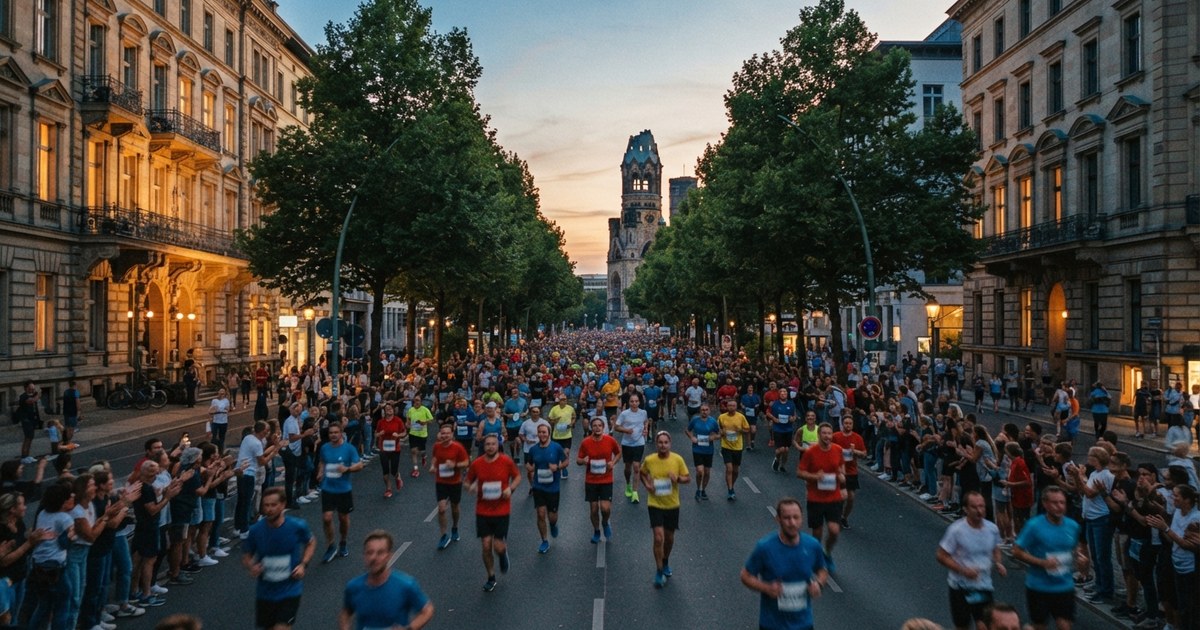
The adidas Runners City Night Berlin takes place on Saturday, 31 July 2027 (source: berlin-citynight.de). It is an evening race: the Kurfürstendamm, West Berlin's main shopping boulevard, is closed to traffic, start and finish are near the Kaiser Wilhelm Memorial Church, and the last gun goes off at 8 pm (source: berlin-citynight.de, event FAQ). That makes the City Night one of the few big Berlin events where you have the whole day to get nervous, which is what much of this guide is about.
The evening at a glance
| Aspect | Details |
|---|---|
| Date | Saturday, 31 July 2027 |
| Start and finish | Kurfürstendamm, near the Kaiser Wilhelm Memorial Church |
| Start times 2026 | 10 km inline skating 6:00 pm · 5 km run 7:00 pm · 10 km run 8:00 pm |
| Time limit | 10 km run 1:30 hours, skating 45 minutes |
| Entry fee 2026 | Run €30, €35 or €40 (price tiers 1–3), youth €21–25 · skating €35–45 |
| Double start | 10 km skating plus 10 km run, second entry €20 |
| Last edition | 1 August 2026, more than 16,350 runners and skaters (participation record) |
| Organiser | SCC EVENTS |
Sources: berlin-citynight.de (home, 5 km, 10 km, 10 km inline skating, special offers, event FAQ, news). The organiser will publish the exact 2027 start times "in time for registration" (source: berlin-citynight.de, participant info). As of 4 October 2026.
5 or 10 km: two different races on the same street
Choosing a distance at the City Night also means choosing a type of course.
The 5 km starts near Breitscheidplatz and runs straight down the Kurfürstendamm, turning back up at the halfway point. There is a single turnaround (source: berlin-citynight.de, 5 km). For a personal best that is a clean course: hardly any corners, nothing to navigate. The catch is the turnaround itself, where the field brakes and accelerates again. If you start near the front, plan to take it on the inside; if it is your first race, take it calmly.
The 10 km follows a star-shaped course through the old West of Berlin and passes the adidas Cheering Zone on Adenauerplatz several times, with crowds and live bands (source: berlin-citynight.de, 10 km). The course in this form has been in use since 2022 (source: berlin-citynight.de, course). For pacing, that means the loud sections come round more than once. If you speed up every time the crowd lifts you, you pay for it on the quieter stretches in between. Run even and treat Adenauerplatz as a reward, not a sprint.
Under the 2026 rules, young runners born in 2015 or earlier could enter the 10 km, and those born in 2017 or earlier the 5 km (source: berlin-citynight.de, 10 km and 5 km). That makes the short distance an option for families who want to start together.
Double start: skate first, then run
One feature you rarely see elsewhere is the double start. You first cover the 10 km course on inline skates and then run it a second time. You register for one discipline, then message the organiser through the contact form to receive a code for the second entry, which costs only €20. Double starters get their own ranking, in which the skating time is weighted more heavily by a factor (source: berlin-citynight.de, special offers).
The schedule leaves room in between: in 2026 the skaters started at 6 pm with a 45-minute limit, and the 10 km run at 8 pm (source: berlin-citynight.de, event FAQ). Helmets are mandatory for skaters; no helmet, no start (source: berlin-citynight.de, event FAQ).
Racing at 8 pm: plan the whole day
Most races start in the morning. If this is your first evening race, the unfamiliar part is not the distance but the day before it. A few things help:
- Shift your meals, do not skip them. Breakfast and lunch as usual, the last bigger meal in the early afternoon, after that only something light that you know from training. If you barely eat until the evening, you will stand at the start hungry.
- Keep the day quiet. A summer Saturday in Berlin invites bike rides and hours at the lake. Both cost legs and fluids. Plan the afternoon so you do not arrive tired.
- Rehearse the start time. In the weeks before, put one or two faster sessions in the evening. That way you know how your stomach and legs react at that hour.
- Travel with a buffer. The organiser recommends public transport, ideally via the U-Bahn (underground) station Wittenbergplatz; there are no reserved parking spaces (source: berlin-citynight.de, event FAQ).
- Hand in a change of clothes. Bag storage costs €5 and can only be booked in advance with your registration, not on race day (source: berlin-citynight.de, extras). There are no showers on site (source: berlin-citynight.de, event FAQ).
The race goes ahead in any weather unless the German Weather Service has issued a warning (source: berlin-citynight.de, participant info). At the end of July that can also mean it is still warm at 8 pm. Drink through the day and do not start too fast.
Registration: being early pays twice
Prices at the City Night rise by quota, not by date. In 2026 both the 5 and the 10 km cost €30 in tier 1, then €35 and €40; youth paid €21 to €25. As soon as one tier sells out, the next one applies (source: berlin-citynight.de, 10 km). As of early October 2026, the organiser had not published prices for 2027.
The bigger reason to register early is availability: shortly before the 2026 race the 10 km was fully booked, with only a few places left in the 5 km and the skating race (source: berlin-citynight.de, news of 31 July 2026). Before you sign up, note that fees are not refunded if you cannot start, and your place cannot be transferred to another person or another year. Switching discipline costs a €5 fee plus the price difference, as long as places are available (source: berlin-citynight.de, participant info). Ticket insurance can be added during registration. You register through a personal SCC EVENTS account, linked from the official City Night website.
Age-group winners from M/W40 upwards in the 10 km receive a free entry for the following year (source: berlin-citynight.de, participant info).
Looking back: 1 August 2026
The 2026 edition set a participation record with more than 16,350 runners and skaters (source: berlin-citynight.de, news of 3 August 2026). More than 11,600 people ran the 10 km, which according to the organiser had sold out weeks in advance, just under 4,400 the 5 km, and around 420 were on skates (source: berlin-citynight.de, news of 3 August 2026).
It was fast. Kifle Kefyalew won the men's 10 km in 28:03, improving Hendrik Pfeiffer's course record from the previous year (28:27), ahead of Aaron Bienenfeld (28:29). Esther Pfeiffer won the women's race in 31:20 ahead of Fabienne Königstein (31:57). The 5 km went to Elias Kolar in 14:25 and Anne Gebauer in 16:46 (source: berlin-citynight.de, news of 3 August 2026).
Because of construction work, the 2026 finish was moved a few hundred metres towards Wittenbergplatz, while the start stayed in its usual place near Joachimsthaler Platz (source: berlin-citynight.de, news of 3 August 2026). As of early October 2026, the organiser had not said whether that will be the case again in 2027. At the finish you get a medal that glows in the dark; engraving with your name and time costs €15 if pre-ordered (source: berlin-citynight.de, home and extras).
Summer training with a group
The City Night falls in midsummer, about eight weeks before the Berlin Marathon on 26 September 2027 (source: scc-events.com, event calendar). Many autumn marathoners use the 10 km on the Ku'damm as a speed test. The next step in that sequence, at the end of August, is die Generalprobe ("the dress rehearsal"), a half marathon in Steglitz.
Summer is a pleasant time to train as long as you take the heat seriously: run early in the morning or in the evening, and use the evening runs to practise the City Night start time. It is easiest in company. Berlin running groups and run clubs with regular evening sessions are listed under running in Berlin, and the rest of the year's races are in our overview of running events in Berlin.
Sources
- berlin-citynight.de
- berlin-citynight.de/anmelden/5-km-lauf
- berlin-citynight.de/anmelden/10-km-lauf
- berlin-citynight.de/anmelden/10-km-inlineskating
- berlin-citynight.de/anmelden/sonderaktionen
- berlin-citynight.de/anmelden/extras
- berlin-citynight.de/event/event-info
- berlin-citynight.de/event/event-faq
- berlin-citynight.de/event/strecke
- berlin-citynight.de/news-medien/detail/adidas-runners-city-…
- berlin-citynight.de/news-medien/detail/sommernacht-der-reko…
- scc-events.com/events-scc-events.ics
Frequently asked questions
- When is City Night Berlin 2027?
- On Saturday, 31 July 2027. The organiser will announce the exact 2027 start times with registration; in 2026 skaters started at 6 pm, the 5 km at 7 pm and the 10 km at 8 pm (source: berlin-citynight.de).
- Which distances are there?
- 5 km and 10 km running, 10 km inline skating, and a double start combining 10 km skating and 10 km running. The second entry for the double start costs €20 (source: berlin-citynight.de, special offers).
- How much does it cost?
- In 2026 the 5 and 10 km cost €30, €35 or €40 depending on the price tier, youth paid €21 to €25 and skating cost €35 to €45. As of early October 2026, prices for 2027 had not been published (source: berlin-citynight.de, 10 km and inline skating).
- Do I get my fee back if I cannot start?
- No. The organiser does not refund entry fees, and places cannot be transferred to another person or year. You can add insurance when you register (source: berlin-citynight.de, participant info).
- How do I get to the start?
- By public transport, ideally via the U-Bahn station Wittenbergplatz according to the organiser. There are no reserved parking spaces, and road closures cause traffic disruption (source: berlin-citynight.de, event FAQ).