Novaled Citylauf Dresden 2027: a 10K to open the season
On 21 March 2027, the Novaled Citylauf Dresden holds its 37th edition: 5 and 10 km on a loop over two Elbe bridges. Here is what to expect, how prices rise and how to use the race as a form check.
Daniel Gruber · 4 October 2026 · 7 min read
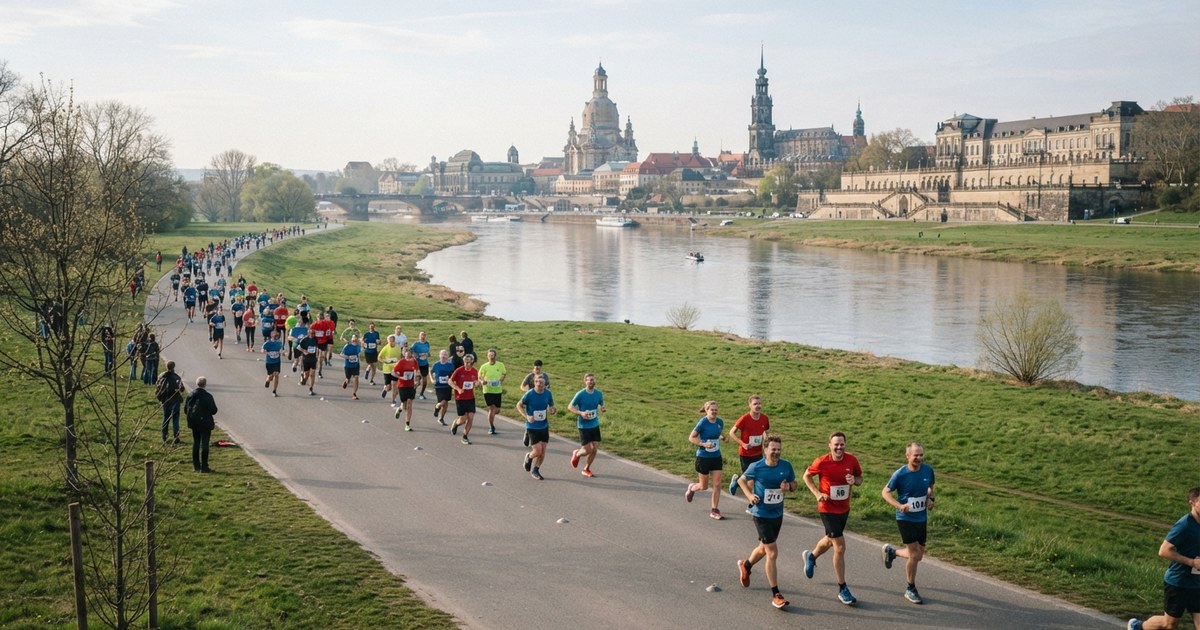
The 37th Novaled Citylauf Dresden takes place on Sunday, 21 March 2027, with start and finish on the Terrassenufer next to the Augustus Bridge (source: citylauf-dresden.de, information). The programme includes 10 km, 5 km, a 2 km kids' run and a 450 m run for the youngest. Registration for 2027 has been open since the day after the last edition (source: citylauf-dresden.de, news). For many runners in Dresden, the Citylauf is the first race of the year: it shows what the winter has brought.
Key facts
| Aspect | Details |
|---|---|
| Date | Sunday, 21 March 2027 (37th edition) |
| Start and finish | Terrassenufer, next to the Augustus Bridge |
| Start times | 2 km kids' run 8:00 · 450 m Bambini run 8:40 · 5 km 9:00 · 10 km elite 10:00 · 10 km 11:00 |
| Finish closes | 5 km 9:45 · 10 km 12:30 |
| Course | 5 km loop through the old town and over two Elbe bridges, 10 km = two laps; certified for record lists |
| 10 km fee | €30 (places 1–500) · €35 (501–1,500) · €40 (1,501–3,000) · €45 (from 3,001) |
| 5 km fee | €25 · €27 · €30 · €35 (same tiers) |
| Children | 2 km kids' run €12, Bambini run free |
| Included | Public transport ticket for the Dresden fare zone on race day, timing, pacers, medal, certificate |
| Pacers | 10 km: 40, 50, 60 minutes · 5 km: 20, 25, 30 minutes |
| Last edition | 22 March 2026, 6,002 participants including children (record) |
Sources: citylauf-dresden.de (information, news). As of 3 October 2026.
The elite first, then you
The race-day schedule has a feature worth using: the fastest 10 km runners start an hour before everyone else. The elite race at 10:00 is meant for men under 40 and women under 45 minutes; the open 10 km starts at 11:00 (source: citylauf-dresden.de, information). The level is high: in 2026 Kefyalew Kifle won in 28:37 and Domenika Mayer took the women's race in 32:33 (source: citylauf-dresden.de, 2026 race report). The course records are 28:15 (Dariusz Kruczkowski, 2001) and 31:40 (Purity Gitonga, 2024) (source: citylauf-dresden.de, information).
The organizer itself points out that the elite race is a chance to watch top runners up close and cheer them on (source: citylauf-dresden.de, news). If you run in the open field, you can spend most of the hour before your own start at the roadside, see the loop and warm up gently. Just make sure you are back in time: entries close half an hour before each start, as long as the field limit has not been reached (source: citylauf-dresden.de, information).
Two laps, two bridges
The race uses a 5 km loop. From the Terrassenufer by the Augustus Bridge, it crosses the Marienbrücke to the Neustadt side, follows Große Meißner Straße and Wigardstraße past the Augustus Bridge, the Golden Rider statue and the Saxon State Chancellery to the Albertbrücke, crosses the Elbe again and returns from Sachsenplatz along the Terrassenufer to the finish. The 10 km runs this loop twice (source: citylauf-dresden.de, information).
For your race, that means two bridge climbs per lap, four over 10 km. The organizer publishes no elevation figure but describes the course as fast and good for a personal best (source: citylauf-dresden.de, information). The 5 km and 10 km courses are measured by a WA/AIMS-DLV surveyor and count for national and international record lists (source: citylauf-dresden.de, information). Your Citylauf time is a reliable number for planning the rest of your season.
A few tips for the two laps:
- Lap one is your test. After 5 km you know how the bridges feel. If you are already breathing hard there, don't speed up on lap two.
- Run the bridges by feel, not by watch. Keep an even effort on the ramps and make the time back downhill and on the flat.
- Use the pacers. Over 10 km there are pacers for 40, 50 and 60 minutes, over 5 km for 20, 25 and 30 minutes. Just join the right one in the start area (source: citylauf-dresden.de, information).
Net time is recorded; places 1 to 10 are decided on gun time (source: citylauf-dresden.de, information). Along the course there are drinks plus samba and drum bands, and at the finish drinks and fruit (source: citylauf-dresden.de, information). Since 2026 the start/finish area has been on the Terrassenufer: stage, changing rooms and toilets are up at Theaterplatz, bib pick-up and bag drop at the Italienisches Dörfchen (source: citylauf-dresden.de, news „Neues Start- und Zielareal“).
What the Citylauf tells you about your form
Its late-March date makes the Citylauf a form check after winter. If you are planning a spring half or full marathon, you get an honest number under race conditions. The Leipzig Marathon, for example, takes place on 18 April 2027, four weeks after the Citylauf (source: leipzigmarathon.de, 2027 race regulations). Four weeks is enough to work a test result into your plan: either confirm your target pace or adjust it in time.
To make the test meaningful:
- Race it, don't train through it. A form check only counts if you actually push.
- Keep the week before lighter. One or two easy days before race day are enough for 10 km.
- Compare with past years. Results going back to 2014 are on the organizer's website (source: citylauf-dresden.de, results). If you have run it before, you get a direct comparison on the same course.
If you are not ready for a fast 10 km in late March, take the 5 km at 9:00. That race also includes the R5K series, a road-race series for U20 and U23 talents whose 2026 season opened in Dresden and ended at the Berlin Marathon (source: citylauf-dresden.de, information).
Registration: prices by bib number
Registration runs online via the Citylauf registration page on the official website. Prices rise not by date but by entry number: the first 500 entries pay €30 for the 10 km, places 501 to 1,500 pay €35, 1,501 to 3,000 pay €40 and from 3,001 it is €45. For the 5 km it is €25, €27, €30 and €35 (source: citylauf-dresden.de, information). When the tiers fall depends only on how quickly others sign up. For reference: ten days before the 2026 edition, more than 4,500 entries were already in (source: citylauf-dresden.de, news „Mehr als 4.500 Anmeldungen“).
More on registration:
- Race-day entries: €5 surcharge. There are no extra costs for chip or bag drop (source: citylauf-dresden.de, information).
- Transfers: If you can't start, pass your place on via the link in your confirmation email. This costs €10 (source: citylauf-dresden.de, information).
- Age limits: 10 km from age 14, 5 km from 10, kids' run 6 to 16, Bambini run 3 to 7 (source: citylauf-dresden.de, information).
- Getting there: Your race pass and bib work as a ticket in the Dresden fare zone on race day, for regional trains, S-Bahn, trams, buses and ferries. The organizer provides no parking (source: citylauf-dresden.de, information).
From every 5 km and 10 km entry, €1 goes to youth running projects (source: citylauf-dresden.de, information).
With family, school or running group
The Citylauf is a kids' event too: in 2026 the 6,002 participants included 1,760 children and 539 Bambinis (source: citylauf-dresden.de, 2026 race report). In the 2 km kids' run, the school with the most entrants wins €500, with €250 and €125 for second and third, and there is a club ranking with vouchers of the same value. Schools and clubs can enter any number of children for a €50 handling fee using a form that must arrive by 10 March 2027 (source: citylauf-dresden.de, information). Make sure the school or club name is spelled the same way on every entry.
There is no adult team ranking, but the schedule suits a running group: the kids run at 8:00, the 5 km group at 9:00, and the 10 km runners start at 11:00 with time to cheer everyone before.
For training through the winter, a regular group helps. You will find Lauftreffs (group runs) and run clubs under running in Dresden. The Citylauf organizer also runs monthly group sessions at the Heinz-Steyer-Stadion, the „Laufszene Open Stadium“, free with registration (source: citylauf-dresden.de, news). All other races in the city are listed in the yearly overview of running events in Dresden. If you are planning a longer distance in autumn, see our guide to the Dresden Marathon.
Sources
- citylauf-dresden.de
- citylauf-dresden.de/informationen
- citylauf-dresden.de/news
- citylauf-dresden.de/news/detail/citylaufdresden-1
- citylauf-dresden.de/news/detail/anmeldung-fuer-2026
- citylauf-dresden.de/ergebnisse
- citylauf-dresden.de/anmelden
- leipzigmarathon.de/49-leipzig-marathon-2027
Frequently asked questions
- When is the Citylauf Dresden 2027?
- The 37th Novaled Citylauf Dresden is on Sunday, 21 March 2027. The 5 km starts at 9:00, the open 10 km at 11:00 (source: citylauf-dresden.de, information).
- Where are the start and finish?
- On the Terrassenufer by the Augustus Bridge. Bib pick-up and bag drop are at the Italienisches Dörfchen, changing rooms and toilets at Theaterplatz (source: citylauf-dresden.de, information and news).
- How much does it cost?
- Prices rise by entry number: the 10 km costs €30, €35, €40 or €45, the 5 km €25, €27, €30 or €35. The kids' run is €12, the Bambini run free. Race-day entries cost €5 extra (source: citylauf-dresden.de, information).
- Is the course fast?
- The organizer describes it as a fast course for personal bests. Each 5 km lap has two bridge crossings; the 5 and 10 km are WA/AIMS-DLV measured and count for record lists (source: citylauf-dresden.de, information).
- Are there pacers?
- Yes, over 10 km for 40, 50 and 60 minutes and over 5 km for 20, 25 and 30 minutes (source: citylauf-dresden.de, information).
- Can I transfer my entry?
- Yes, via the link in your confirmation email. A transfer costs €10; passing on a bib any other way leads to disqualification (source: citylauf-dresden.de, information).