Hannover Marathon 2027: relay, flat course and nationals
The ADAC Marathon Hannover runs for the 35th time on 11 April 2027. How your running group can split the relay, what 19 metres of elevation means on race day and what registration costs.
Daniel Gruber · 4 October 2026 · 7 min read
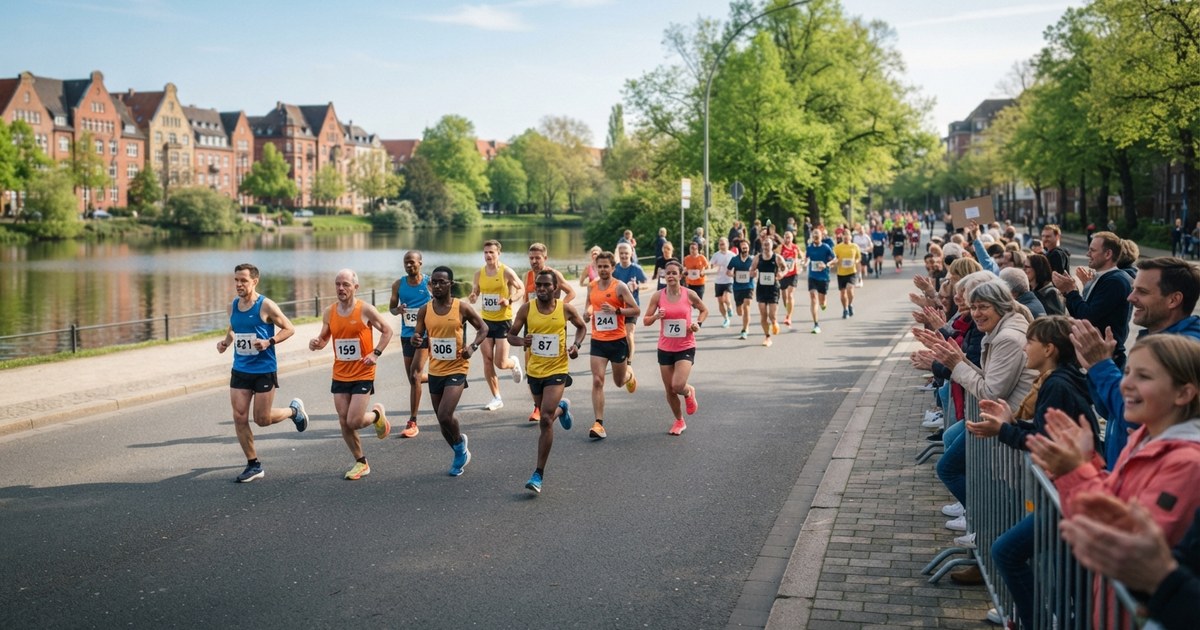
The 35th ADAC Marathon Hannover takes place on Sunday, 11 April 2027, with start and finish on Friedrichswall in front of the New Town Hall (source: marathon-hannover.de). Hannover is not a race you travel to only as a lone runner: over one weekend there are distances from 800 metres to 42.195 kilometres, a marathon relay that two to six people split however they like, and a team ranking for clubs (source: marathon-hannover.de, disciplines and relay). Add a course the organiser lists with only 19 metres of elevation difference, and the German Marathon Championships for the fourth year running (sources: marathon-hannover.de, course; leichtathletik.de).
The weekend at a glance
| When | What | Start | Course closes |
|---|---|---|---|
| Saturday, 10 April | HAZ-Minithon (4.2 km, one lap) | 13:00 | – |
| Saturday, 10 April | School, kids and family runs (approx. 800 m each) | 14:00 to 15:55 | – |
| Sunday, 11 April | ROSSMANN 10K | 9:00 | 10:45 |
| Sunday, 11 April | Marathon (two waves) | 10:00 and 10:05 | 16:00 |
| Sunday, 11 April | enercity marathon relay | from 10:30 | – |
| Sunday, 11 April | Half marathon (four waves) | from 11:30 | 16:00 |
| Sunday, 11 April | Nordic walking half marathon | from 12:20 | 16:00 |
Sources: marathon-hannover.de (family day, 10 km, marathon, relay, half marathon). As of 3 October 2026; the organiser reserves the right to make changes.
Minimum age is 18 for the marathon, 16 for the half and 12 for the 10 km (source: marathon-hannover.de, general info). Bibs are handed out at the marathon expo on Friday from 12:00 to 19:00 and Saturday from 10:00 to 19:00. On Sunday, marathon pick-up is only open from 7:00 to 8:30, half-marathon pick-up until 12:00 (source: marathon-hannover.de, marathon and half marathon).
The relay: a marathon for the whole running group
The enercity Staffel-Marathon (marathon relay) is the format in Hannover that fits a running group best. The 42.195 kilometres are split into six legs of 4.6 to 9.6 kilometres, and a team of two to six people divides them as it likes (source: marathon-hannover.de, relay):
| Leg | Length | From | To | Kilometre |
|---|---|---|---|---|
| 1 | 7.4 km | Start, Friedrichswall | Hildesheimer Straße | 7.4 |
| 2 | 7.1 km | Hildesheimer Straße | Waldchaussee, zoo | 14.5 |
| 3 | 6.5 km | Waldchaussee, zoo | Podbielskistraße | 20.8 |
| 4 | 7.2 km | Podbielskistraße | Celler Straße | 28.0 |
| 5 | 4.6 km | Celler Straße | Vahrenwalder Straße | 32.6 |
| 6 | 9.6 km | Vahrenwalder Straße | Finish, Friedrichswall | 42.195 |
Source: marathon-hannover.de, course.
That lets you build teams across very different fitness levels. Someone who has just reached five kilometres takes leg 5. Someone training for a half marathon runs legs 1 to 3 in one go and hands over at km 20.8. With six people, everyone runs one leg; with two, you split the race into halves. The relay starts from 10:30 with its own gun on Friedrichswall, and the organiser says the changeover zones are easy to reach by public transport. Every team needs a team captain aged 18 or over (source: marathon-hannover.de, relay).
How popular the format is showed in 2026: 893 teams with around 5,000 runners took part in the relay (source: germanroadraces.de, 2026 review).
For clubs that prefer to run individually, the marathon has a team ranking: the first three finishers from a club or other organisation form a team in order of arrival, and their times are added up (source: marathon-hannover.de, marathon). Group entries are possible from ten people (source: marathon-hannover.de, registration).
19 metres of elevation: what flat means on race day
The organiser counts the course among the flattest in Germany, with just 19 metres of elevation difference. All courses are officially measured and record-eligible (source: marathon-hannover.de, course). The relay changeover zones and the organiser's course highlights trace the route: from Friedrichswall it first heads south to Hildesheimer Straße, then back via Aegidientorplatz at km 11 to the main station at km 12. From the zoo at km 14.4 the course runs through the Eilenriede, one of the largest urban forests, and at km 19.7 over the Noltemeyer bridge on the Mittelland Canal. Then it goes through the List district, along Celler Straße and Vahrenwalder Straße to Leibniz University at km 39 and, in the final kilometres, past the Hohes Ufer with its Nana sculptures and the Lower Saxony state parliament to the finish (sources: marathon-hannover.de, course and course highlights).
A flat course is not automatically an easy one. Without climbs there are no natural changes that make legs and mind work differently for a while, and holding pace from the start to km 42 is entirely down to you. That is what the pacers are for: in the marathon they cover 3:00 to 5:00 hours in 15-minute steps, in the half 1:30 to 2:30 hours (source: marathon-hannover.de, marathon and half marathon). If you want to be fast on the flat, practise long, even stretches at race pace rather than looking for hills. Along the way, more than 90 stations provide atmosphere, according to the organiser (source: marathon-hannover.de, course).
On the course with the best
On 11 April 2027, Hannover hosts the German Marathon Championships for the fourth consecutive year. The German athletics federation sees them as a step towards the 2027 World Championships in Beijing and the 2028 Olympics in Los Angeles (source: leichtathletik.de, news of 6 August 2026). For you, that means the championship runners and the elite stand in the same first wave at 10:00 as blocks B and C (source: marathon-hannover.de, marathon).
In 2026 around 33,800 athletes registered across all races. Domenika Mayer won the marathon for the third year in a row and lowered her own course record to 2:21:26; the men's race went to Maru Kibet Thomas of Kenya, and Tom Thurley became German champion (source: germanroadraces.de, 2026 review).
Registration: prices by quota
Registration for 2027 is open. Prices rise not by date but by the number of entries. In the marathon, a place in the 1,001 to 2,500 quota costs €99, from 2,501 to 4,000 €105 and from 4,001 €115. In the half marathon, €74 is listed for the 6,001 to 10,000 quota and €82 from 10,001. The 10 km costs €35 to €45 depending on the quota, the relay €170 to €190 per team. For the first quotas (marathon up to 1,000, half marathon up to 6,000, 10 km up to 1,000, relay up to 200 teams) the registration page showed no price in early October 2026, only an arrow. Family day races cost €8 to €12 (source: marathon-hannover.de, registration). Note: if you do not start, the fee is not refunded (source: marathon-hannover.de, registration). Students at Leibniz University and partner universities get 40 per cent off the marathon and relay and 25 per cent off the half and 10 km through university sports (source: hochschulsport-hannover.de).
The entry fee includes free public transport, food and drink on the course and at the finish, showers and, for marathon runners, a massage after the race (source: marathon-hannover.de, marathon).
Train together, travel together
If you are starting as a relay, it pays to train together through the winter so everyone knows their leg. In Hannover you will find running groups and Lauftreffs (group runs) under running in Hannover, and the rest of the year's races in the overview of running events in Hannover. On the same Sunday, the Deutsche Post Marathon Bonn takes place, and one week earlier the two-lap Mein Freiburg Marathon. More dates are in the marathon calendar 2027, and the big races are compared in our article on Germany's biggest marathons.
Sources
- marathon-hannover.de
- marathon-hannover.de/ergebnisse-1.html
- marathon-hannover.de/anmeldung/anmeldung.html
- marathon-hannover.de/teilnehmer/disziplinen.html
- marathon-hannover.de/teilnehmer/allgemeine-infos/marathon.h…
- marathon-hannover.de/teilnehmer/allgemeine-infos/halbmarath…
- marathon-hannover.de/teilnehmer/allgemeine-infos/10-km-lauf…
- marathon-hannover.de/teilnehmer/allgemeine-infos/marathon-s…
- marathon-hannover.de/strecken/streckenverlauf.html
- marathon-hannover.de/strecken/streckenhighlights.html
- marathon-hannover.de/programm/familientag.html
- leichtathletik.de/aktuelles/news/news-detail/82183-marathon…
- news.germanroadraces.de/adac-marathon-hannover-2026-strecke…
- hochschulsport-hannover.de/der-hochschulsport/news-und-vera…
Frequently asked questions
- When is the Hannover Marathon 2027?
- On Sunday, 11 April 2027. The family day with the Minithon and school, kids and family runs is on Saturday, 10 April (source: marathon-hannover.de).
- When do the marathon, half marathon and 10 km start?
- The 10 km starts at 9:00, the marathon at 10:00 in two waves (block D at 10:05), the relay from 10:30 and the half marathon from 11:30 in four waves. The course closes at 16:00 for marathon and half (source: marathon-hannover.de).
- How does the Hannover marathon relay work?
- Two to six people freely split six legs of 4.6 to 9.6 kilometres. Every team needs a team captain aged 18 or over; the fee is €170 to €190 per team (source: marathon-hannover.de).
- How much does the Hannover Marathon 2027 cost?
- Prices follow quotas: the marathon €99 (1,001 to 2,500), €105 (2,501 to 4,000) and €115 (from 4,001); the half marathon €74 (6,001 to 10,000), then €82; the 10 km €35 to €45. There is no refund if you do not start (source: marathon-hannover.de, registration).
- Is the Hannover course flat?
- Yes. The organiser gives only 19 metres of elevation difference and counts it among the flattest courses in Germany. All courses are officially measured and record-eligible (source: marathon-hannover.de, course).