Schwarzwald-Marathon 2027 in Bräunlingen: forest course with history
Since 1968, Bräunlingen near Donaueschingen has hosted one of Germany's oldest marathons – 80 percent on forest tracks, uphill for the first half. What to expect, how to pace the climb and what is already known for 2027.
Daniel Gruber · 4 October 2026 · 8 min read
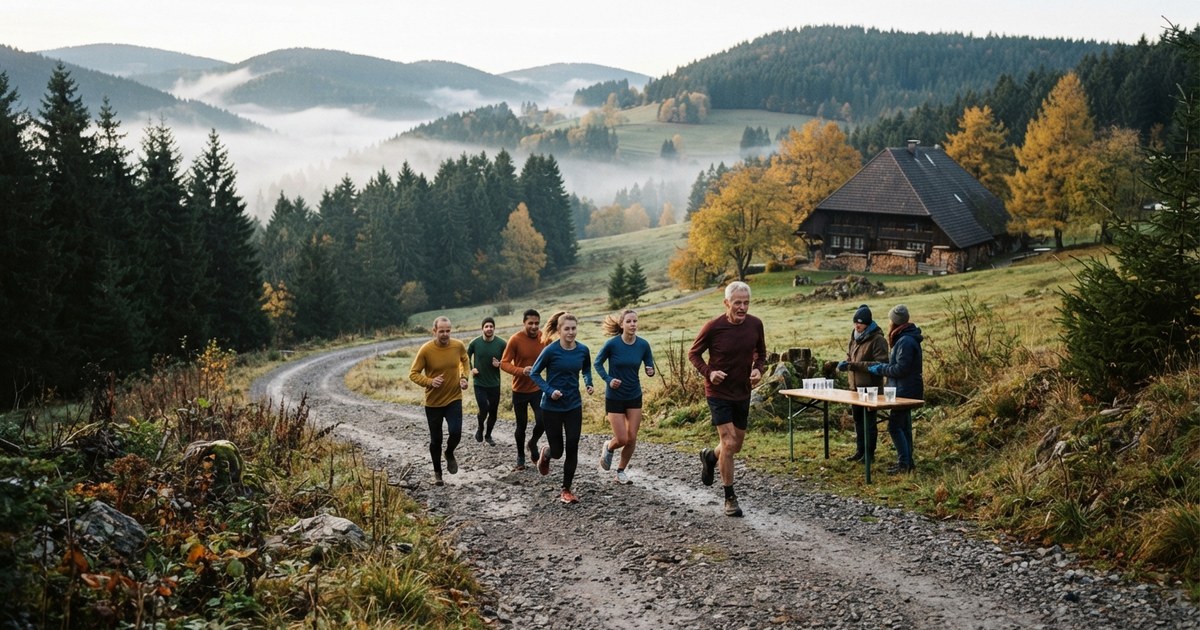
The Schwarzwald-Marathon (Black Forest Marathon) is not a city marathon that happens to be surrounded by trees. It has been held since 1968 in Bräunlingen near Donaueschingen on the Baar plateau, around 80 percent of the course runs on well-packed forest tracks, and the first half goes uphill (source: schwarzwaldmarathon.de, home and marathon). The organiser calls it the world's oldest nature marathon and the oldest marathon open to women. The 58th edition takes place on 10 and 11 October 2026. This page looks ahead to 2027: what to expect on the course, how to pace the climb and what you need to know about getting there from Freiburg.
The 2027 date has not been announced yet (as of 3 October 2026). Since its founding, the races have always been held on the second weekend of October (source: schwarzwaldmarathon.de, home).
At a glance
| 2026 edition (for orientation) | |
|---|---|
| Date | 10 and 11 October 2026 (58th edition) · 2027: to be announced |
| Venue | Bräunlingen, start at the Stadthalle (town hall) |
| Sunday | Marathon and marathon relay 9:30 am · half marathon 10:00 am · 5 km approx. 10:30 am · kids' run approx. 2:30 pm |
| Saturday | School and youth races 2:00 and 2:20 pm · 10 km run 3:00 pm · 10 km Nordic walking/walking 3:10 pm |
| Marathon surface | 80% forest tracks, 20% tarmac; gently rising to about km 21, then gently falling |
| Time limit | Marathon 6 hours, half marathon 3 hours, finish closes 3:30 pm |
| Relay | 4 legs: 11.1 · 6.6 · 16.5 · 8 km |
| Marathon course records | Men 2:22:58 (Moses Cheserek, 2003) · women 2:45:26 (Stefanie Doll, 2022) |
| 2025 edition | 4,136 participants over both days, a record |
Sources: schwarzwaldmarathon.de (marathon, half marathon, relay, 2026 programme, FAQ), de.wikipedia.org (course records), bwleichtathletik.de (2025 report). As of 3 October 2026.
A piece of running history
The Schwarzwald-Marathon was founded in 1968 by SV Donaueschingen and TuS Bräunlingen (source: schwarzwaldmarathon.de, home). It is considered the first marathon in West Germany aimed at recreational runners, and it had a women's category from the very start: in 1968 around 51 women started and 48 finished (source: de.wikipedia.org, Schwarzwald-Marathon). In 1975 the German athletics federation held its first national women's marathon championship in Bräunlingen (source: de.wikipedia.org). Starting here means running a course where women raced the marathon at a time when that was not possible in many other places.
The course: climb first, then let it roll
The elevation profile is the heart of this event. The marathon rises gently until about kilometre 21 and then falls gently; every kilometre is marked (source: schwarzwaldmarathon.de, marathon). Bräunlingen sits at around 700 metres; at kilometre 17 the course reaches about 1,000 metres and then runs mostly downhill past the Brändbach reservoir to the finish (source: de.wikipedia.org). The organiser does not publish an official total elevation gain.
What does that mean for your race?
- Climb by feel, not by watch. Your splits over the first 17 to 21 kilometres will be slower than on the flat. Forcing flat-course pace here costs you on the way back. Run by breathing and effort.
- Downhill needs training. The second half descends, and your quads will notice. Add longer runs with downhill sections in the weeks before.
- Forest floor is not tarmac. The organiser points out that you will keep meeting uneven ground on the forest tracks (source: schwarzwaldmarathon.de, FAQ). A shoe with a bit more grip and cushioning is often a better choice here than a carbon racing shoe.
- No toilets on the course. There are toilets in and in front of the Stadthalle, at the start and at the finish, but none along the route (source: schwarzwaldmarathon.de, FAQ). Aid stations with water, sports drink and juice come every 5 kilometres, with bananas from kilometre 10. Bring your own gels and bars (source: schwarzwaldmarathon.de, FAQ).
The half marathon is 70 percent forest track and climbs gently until kilometre 12 (source: schwarzwaldmarathon.de, half marathon). Both distances share the course up to the split at kilometre 12.
The cut-offs you need to know
The marathon has a 6-hour limit, the half marathon 3 hours. These checkpoints were published for 2026 (source: schwarzwaldmarathon.de, FAQ):
| Point | Marathon | Half marathon |
|---|---|---|
| km 12 (marathon/half split) | 11:12 am | 11:42 am |
| km 18 (Oberbränd) | 12:03 pm | 12:34 pm |
| km 34.5 (Unterbränd) | 2:24 pm | – |
| Finish | 3:30 pm | 1:00 pm |
One detail takes the pressure off newcomers: if you can't make the marathon checkpoints, you can switch to the half marathon at the split at kilometre 12 (source: schwarzwaldmarathon.de, FAQ). Run evenly, the time limit works out at 8:32 minutes per kilometre, according to the organiser.
Marathon relay: team sport with your own car
For a running group the relay is the obvious choice: four legs of 11.1, 6.6, 16.5 and 8 kilometres, starting together with the marathon. The minimum age is 16, or 14 for legs up to 10 kilometres (source: schwarzwaldmarathon.de, relay). Important: there is no transfer to the changeover zones – you organise it yourselves. The changeover points are easy to reach by car, about 15 minutes each according to the organiser, who has re-planned the access routes. They explicitly ask teams to use only the recommended route and not to navigate by Google Maps, because apps don't know about the closed roads (source: schwarzwaldmarathon.de, FAQ). In 2026 the first changeover was also moved: the first leg is about 580 metres shorter and the second correspondingly longer (source: schwarzwaldmarathon.de, FAQ).
Split your legs according to the profile: the first leg leads into the climb, and the third is the longest at 16.5 kilometres. If you're looking for a group to train with in Freiburg, running in Freiburg lists Lauftreffs (group runs) and run clubs.
The weekend: short on Saturday, long on Sunday
The Schwarzwald-Marathon is a two-day event. On Saturday the school races go first, followed by 10 kilometres as a run and as Nordic walking and walking. The 10 km run has a team ranking for teams of five and a prize for the largest group; between kilometres 8 and 8.6 there are cross-country sections (source: schwarzwaldmarathon.de, 10 km run). On Saturday afternoon there is a paid Maultaschen party (Swabian pasta pockets) in the Stadthalle, and a free guided town walk in the evening (source: schwarzwaldmarathon.de, 2026 programme).
Sunday brings the marathon, relay and half marathon, later the 5 km run and in the afternoon the kids' run at the Stadthalle (source: schwarzwaldmarathon.de, 2026 programme). If you live nearby, the organiser asks you to collect your race pack on Saturday.
The services around the event stand out: free massage in the sports hall, free bag storage and free mass accommodation in the sports hall (source: schwarzwaldmarathon.de, services). A budget bed is part of the package.
Getting there from Freiburg and Baden-Württemberg
For participants from Baden-Württemberg the train is free: your entry confirmation plus ID is valid for one return trip to Bräunlingen within the area of the Baden-Württemberg-Ticket, all day on race day. Companions need their own ticket (source: schwarzwaldmarathon.de, FAQ and sustainability). Drivers will find signposted parking (source: schwarzwaldmarathon.de, FAQ).
Registering for 2027
In 2026 online registration ran until the Thursday before race weekend; after that you could enter on site in the Stadthalle on Saturday from noon and on Sunday from 7 am, up to 60 minutes before each start (source: schwarzwaldmarathon.de, registration). Prices for 2027 have not been published. For 2026, the cheapest fee tier ran until 31 December of the previous year (source: schwarzwaldmarathon.de, FAQ). Entry fees are not refunded, but you can transfer your place to a substitute free of charge (source: schwarzwaldmarathon.de, FAQ). Switching to a shorter distance is possible if places are left, without a refund of the difference (source: schwarzwaldmarathon.de, FAQ). Registration runs via the official Schwarzwald-Marathon registration page.
Looking back at 2025
The 57th edition in October 2025 set a participation record of 4,136 people over both days, in perfect weather. Around 2,000 ran the half marathon, which doubled as the Baden-Württemberg championship, and 47 teams ran the relay. Lennart Nies (2:36:52) and Stefanie Doll (2:53:48) won the marathon; Dominik Sowieja (1:09:35) and Leah Hanle (1:18:02) won the half (source: bwleichtathletik.de, report of 14 October 2025). Hanle's time is the current women's course record for the half marathon (source: de.wikipedia.org).
More in the region
The Schwarzwald-Marathon appears in our annual overview of running events in Freiburg under "Rund um Freiburg" (around Freiburg). If you prefer tarmac in town, run the Mein Freiburg Marathon in April. On the same October weekend, the flat 3-Länder-Marathon takes place on Lake Constance – two autumn marathons that could hardly be more different. More dates for next year are in the 2027 marathon calendar.
The big city marathons, as the counterpoint, are in our overview of Germany's biggest marathons.
Sources
- schwarzwaldmarathon.de
- schwarzwaldmarathon.de/laeufe/marathon
- schwarzwaldmarathon.de/laeufe/halbmarathon
- schwarzwaldmarathon.de/laeufe/staffelmarathon
- schwarzwaldmarathon.de/laeufe/10-km-lauf
- schwarzwaldmarathon.de/laeufe/alle-laeufe
- schwarzwaldmarathon.de/anmeldung
- schwarzwaldmarathon.de/infos/faq
- schwarzwaldmarathon.de/infos/leistungen
- schwarzwaldmarathon.de/infos/programm-2024
- schwarzwaldmarathon.de/nachhaltigkeit
- de.wikipedia.org/wiki/Schwarzwald-Marathon
- bwleichtathletik.de/home/news/detail/news/schwarzwald-marat…
Frequently asked questions
- When is the Schwarzwald-Marathon 2027?
- The 2027 date has not been published yet (as of 3 October 2026). According to the organiser, the races have been held on the second weekend of October since 1968; in 2026 that was 10 and 11 October (source: schwarzwaldmarathon.de, home).
- Where does the Schwarzwald-Marathon take place?
- In Bräunlingen near Donaueschingen. The start is at the Stadthalle; race packs and on-site entries are on the first floor of the Stadthalle (source: schwarzwaldmarathon.de, FAQ and registration).
- How hard is the course?
- The marathon runs 80 percent on forest tracks and rises gently until about kilometre 21, then descends gently (source: schwarzwaldmarathon.de, marathon). According to Wikipedia, the highest point at kilometre 17 is about 1,000 metres, the start around 700 metres.
- How much time do I have?
- 6 hours for the marathon and 3 hours for the half; the finish closes at 3:30 pm. There are checkpoints along the way, in 2026 for example 11:12 am at kilometre 12 and 2:24 pm at kilometre 34.5 (source: schwarzwaldmarathon.de, FAQ).
- Is there a shuttle for the relay?
- No. Teams organise their own transfers to the changeover zones, each about 15 minutes away by car. The organiser asks teams to use the recommended route instead of navigation apps (source: schwarzwaldmarathon.de, FAQ).
- Can I stay cheaply in Bräunlingen?
- Yes, the organiser offers free mass accommodation in the sports hall. Hotels and guesthouses are listed by the Bräunlingen tourist office (source: schwarzwaldmarathon.de, services and FAQ).